Birth trauma
Information and resources for birth and after birth (postpartum) trauma
What is birth trauma?
Birth trauma is when you have a traumatic experience during birth or after birth that can cause lasting distress, no matter how successful your delivery may have been. Birth trauma is determined by the individual. (Greenfield, 2016; Goodwin, 2022)
Birth trauma can cause post-traumatic stress disorder (PTSD), intense anxiety or depression, or obsessive compulsive disorder (OCD). It can affect anyone—you, your partner, or other family and friends who may have been with you during the birth.
Birth trauma can happen when there is:
- Fear for the mother's life or newborn's life.
- A feeling of not being in control during labor.
- Lack of respect and compassion from medical professionals.
- Emergency cesarean section (c-section).
- A significant loss of blood during birth.
- Preterm birth.
- Perinatal loss.
- Pelvic floor injuries.
- Need for resuscitation.
- Other obstetric emergencies or medical complications.*
*This is not meant to be an exhaustive list, since birth trauma is determined by the individual.
Resources for patients, partners, family or friends
Resources for providers
Connect with us and share your story
Signs of birth trauma:
- Avoiding reminders or talking about the birth or traumatic event.
- Experiencing the event as nightmares, flashbacks or intrusive thoughts.
- Feeling anxious having panic attacks, depressed or irritable when thoughts of the event are brought up.
- Having trouble with bowel or bladder habits with no physical abnormalities.
- Pain or difficulty having sex.
- Feeling like your heart is racing, sweating, shaking, stomach upset that is not connected to a medical condition.
- Feeling that you are always on high alert worrying something bad will happen to you or your baby.
- Trouble sleeping, unwanted distressing thoughts.
Find a mental health provider
Find help for depression and anxiety during pregnancy and postpartum (after birth), including specialists in birth trauma. The Utah Maternal Mental Health Referral Network is a directory of professionals and support groups with training in perinatal mental health (perinatal means during pregnancy and postpartum).
Find a support group
Finding others who have gone through similar events can help you find connection and validation for your experiences. There are various support groups lead by trained professionals, which are both online and in-person, local and national.
Important information on birth trauma
 Birth Trauma and Maternal Mental Health Fact Sheet (MMHLA)
Key facts on birth trauma and maternal mental health, quotes from women who have experienced birth trauma, key factors contributing to birth trauma, recommended reading, and where to learn more about birth trauma.
Produced by the Maternal Mental Health Leadership Alliance (MMHLA).

Birth trauma and post-traumatic stress disorder (PTSD) (Huntsman Mental Health Institute)
Find information about birth trauma, perinatal mood disorders, and how to get treatment at the Huntsman Mental Health Institute (HMHI). You can also find information on support groups if you've given birth or have a new baby in the neonatal intensive care unit (NICU).
If you had a traumatic birth, you're not alone.
This is Desiree Ferrin. She nearly died due to delivery complications. Desiree struggled in the aftermath of her traumatic birth experience and emergency hysterectomy. She didn't identify with postpartum depression and anxiety, but knew she wasn’t herself. Her emotions surfaced primarily as postpartum OCD and rage, two lesser known perinatal mental health challenges, yet can deeply impact the well-being of a mother and her family during the postpartum journey. Desiree suffered in silence for months, thinking she was "just being dramatic" or needed to work harder to get over it.
While trying to make sense of her new reality, she found a community of other women who shared similar experiences and she realized she didn’t have to feel this way anymore. With help from a therapist, a lot of support from her family and community, and the friendships and examples from this group of moms, she found a way through the disruption the birth trauma caused in her life.
Desiree Ferrin joined UWNQC in 2023 as the Birth Trauma Patient Family Partner to help UWNQC work to address birth trauma in Utah. From 2023-2025, she interviewed 39 moms who self-identified with having birth trauma. Their stories helped inform the creation of this website. Read the birth trauma report, which summarizes the findings from all 39 interviews, and was a collaboration with the Kem C. Gardner Policy Institute.

Hear her story here.
Watch the CDC Hear Her Campaign video.
You can also read what she wrote for the Salt Lake Tribune about her experience, and the impact her traumatic birth had on her life and her family in her Op-Ed in the Salt Lake Tribune.
Share this website & flyers
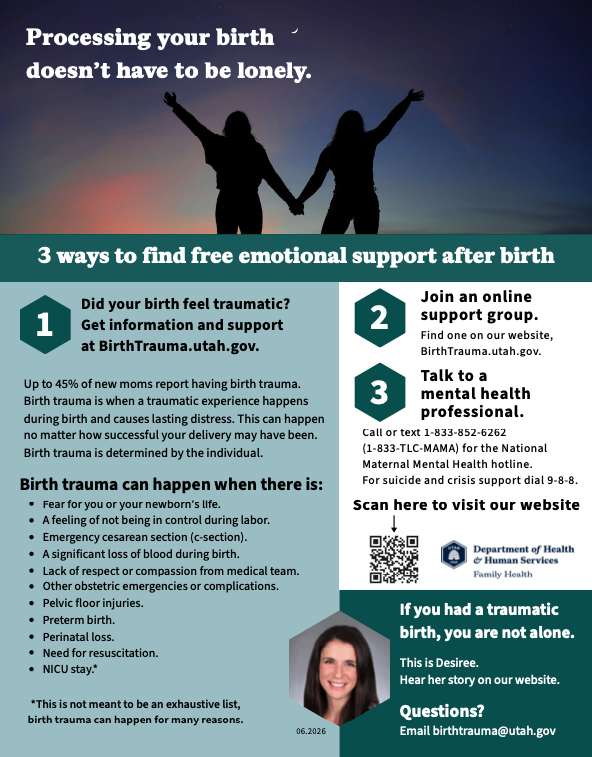
The Utah Department of Health and Human Services may occasionally link to outside sources of information. DHHS and the state of Utah do not necessarily endorse the provider of the content and are not responsible for any content published on the external site.
Disclaimer: The material on this website is provided for educational purposes only and is not to be used for medical advice, diagnosis, or treatment. You should not rely on this information as a substitute for, nor does it replace, professional medical advice, diagnosis, or treatment. If you have any concerns or questions about your health, you should always talk to a doctor or other health care professional. Do not disregard, avoid, or delay obtaining medical or health-related advice from a health care professional because of something you may have read on this site. The use of any information provided on this site is to be used solely at your own risk.